

 My Cart
 My Account
 Gift Certificates
 Find Us

Access Dramaturgy and My Joy is Heavy: A Conversation with Alison Kopit
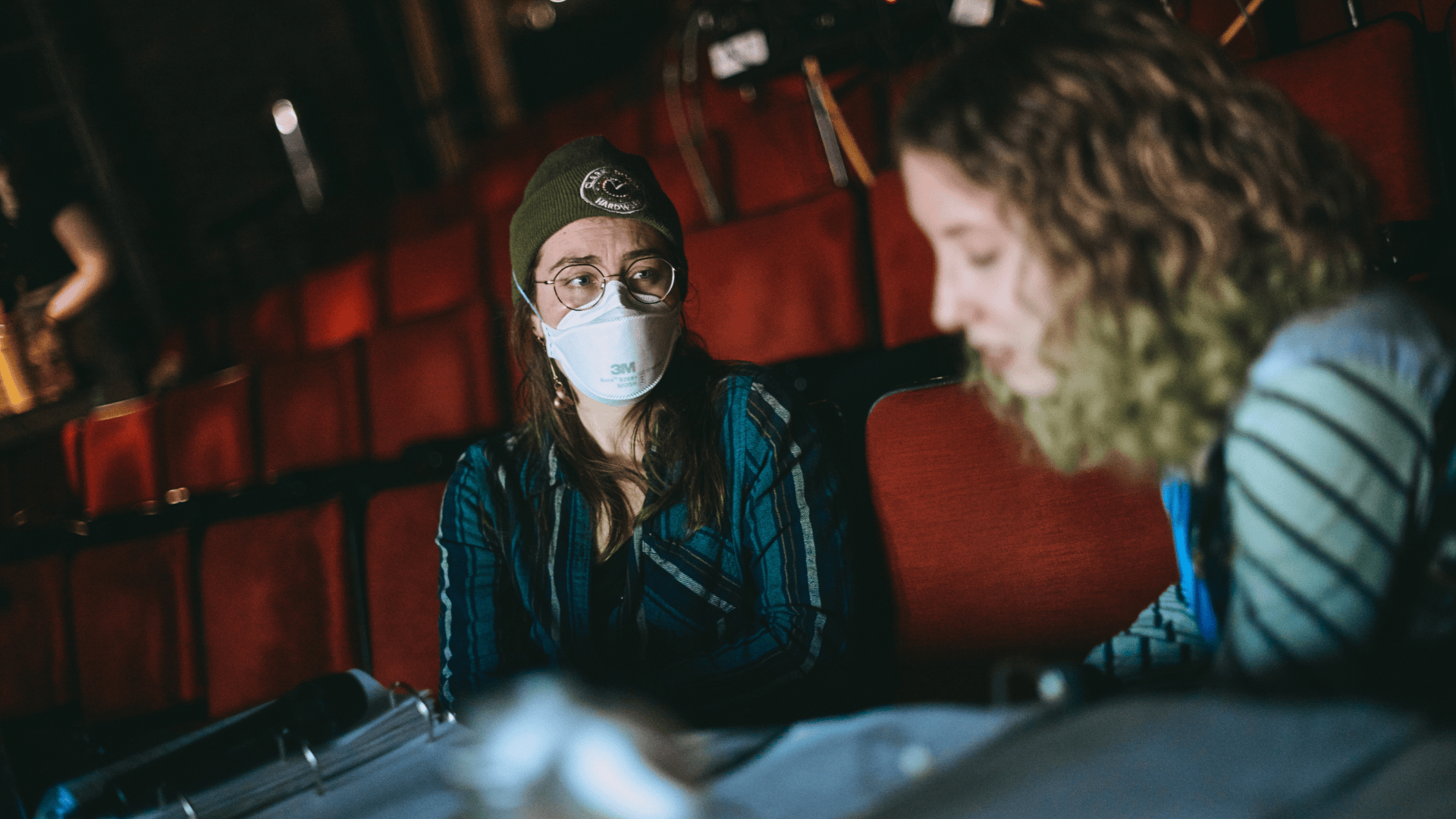
For MY JOY IS HEAVY here at NYTW, access has been woven into both the fabric of the piece itself and the audience experience of the production. From open captions projected onto a dedicated section of the set design to various affinity nights and to technical choices to make every show a relaxed performance, these intentional decisions are the result of many conversations between The Bengsons, the creative team, NYTW staff, and access dramaturg Alison Kopit.
Alison took some time a couple weeks before tech rehearsals began to tell me about her story of developing the practice of access dramaturgy, as well as her work on My Joy is Heavy.
MARTY CHANDLER: I read in your 2024 HowlRound article about some of the origins of your work as an access dramaturg, but I’d love if you could share a bit about that story here: how would you define the role of ‘access dramaturg,’ and how did you come to this work?
ALISON KOPIT: It’s still really in development. I started in 2023, working on a show called Dark Disabled Stories, written by Ryan J. Haddad. We really developed it in that project and also with my collaborator, Maggie Bridger, a disabled dancer in Chicago, who was doing similar access work that had a dramaturgical quality to it. I always understand access to be most effective when it’s really operating at all levels of production, a cultural institution, or wherever you’re doing access work.
I came into theatre as an access worker. I’m not a theatremaker by trade. But when I started working with Ryan, we were realizing that access needs to be a part of meaning-making, and disability needs to be something that we’re really exploring dramaturgically. What are we saying about disability? Is that what we want to say?
I think if I do my job well, I am the connective tissue between various departments as far as how access shows up. I’m not a lighting or sound designer, right? But in order for these elements to all be accessible, the designers become, at least in part, access workers as well. They need to know enough to be able to create accessible material. In this position, I consider multiple levels of access: audience access, access for artists, what access means for an institution, and how disability and access are showing up in the content and text
When I think about how this shows up institutionally, I’m considering how critics are writing about the show, what’s happening with press and marketing, and how we are making tickets accessible to a wide range of people. I try to connect on all those different levels to get access to be something that matches the values of the work. I’ve grown the practice alongside my collaborators by working with artists whose values are pretty aligned with mine, so that we can dream together about new creative directions for access.
MARTY: That leads perfectly into my next question: how did you come to join the process of My Joy is Heavy?
ALISON: The Bengsons and I worked together for Ohio, which they brought to Edinburgh this past year, and I came in at the end of the process. The show was further along in the process, and they were still working on some components of it. [The director] Caitlin Sullivan had been working on that show for a very long time, but as soon as we met, we went really deep, really quickly, thinking about their journey with disability. We were all kind of curious about what it would look like if we were going to work together earlier in a process.
And so, they asked me to do this project, and it was just a very easy ‘yes.’ Our work is very aligned, our values are very aligned, and our collaboration and friendship are important to me.
MARTY: In your work so far on this show, what opportunities have you, The Bengsons, and the creative team already found to integrate access into the piece?
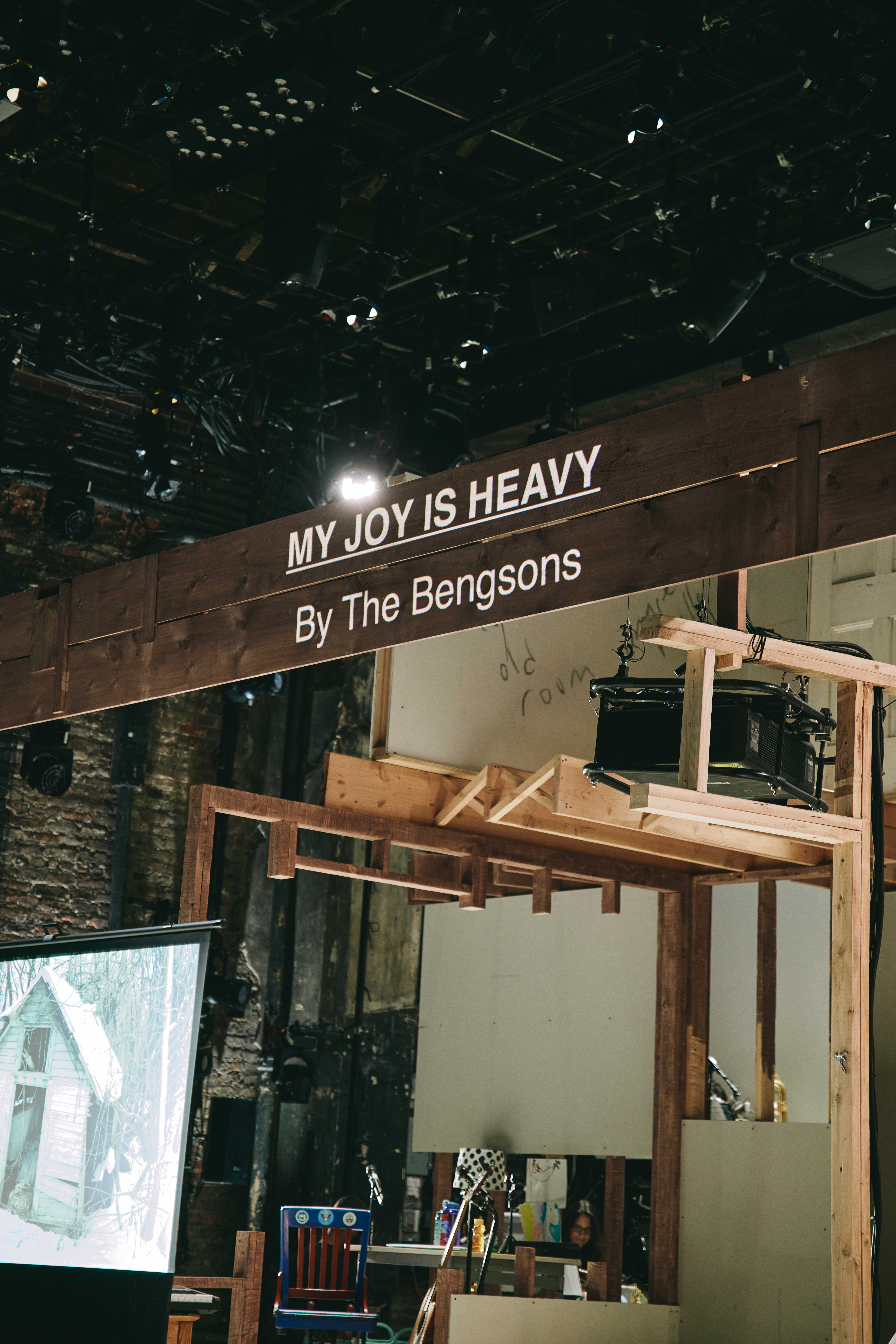
Captions are integrated into the set design for My Joy is Heavy
ALISON: At a dramaturgical level, we are thinking very much about their own evolving relationship over time to disability and really exploring that in the most truthful way we can. It’s fun in this show, because it is a little time-travel-y: the show is a time capsule, and now it’s years later, and they have a different understanding of themselves, and we’re tracking that together.
We are integrating open captions into every show, which, alongside a general community commitment, they also have a personal connection to through Sean’s experience of hearing loss.
Every show is a relaxed audience environment, which we’ve tried to incorporate dramaturgically — it’s the Bengsons’ house rules! We want people to feel welcome to move, to vocalize or express themselves, to come and go as they need. We have the house lights on dim, as well as an access station with earplugs, fidgets, tissues, cough drops, masks, and heating pads. There will also be a few masked performances, and a few audio described performances.
MARTY: Similarly, what has your day-to-day as an access dramaturg looked like while you’ve been in the rehearsal room, and outside of the rehearsal room, during this process?
ALISON: I started in the room the first week, and we were working with the script, setting blocking and choreography. And now, working remotely, I’m doing a lot of back-end stuff with the producers, thinking about the access table, working on a page for the press kit, and things that are not based in the script but are other kinds of support. Then, when I’m in tech, I can be back working on the content of the show. I am always bouncing between these different prongs of the job.
MARTY: And what do you hope for audiences to experience and take away from this show?
ALISON: I want people to understand that access can be a part of meaning-making. The approach that we take to access is called integrated access. Integrated access is access that is baked in—it is a part of the creative process. Something would be missing from the show if you take it out. It is really intertwined, as opposed to what I would call more logistical access, which is like if you have a screen that’s all the way stage left and it’s saying the words and the actors will know it’s there, but it’s not necessarily a part of the meaning-making.
So, this is integrated access. I think it can be very compelling and effective, and generative when you start integrating access from the devising stage. So, I always want to get in the room as soon as I can.
I also want people to understand that open access is access for everyone. It is meaningful, regardless of whether someone needs that accommodation or not, and might also give you insight into your own access needs, or those of others. I think of it as a representational project, as well as something functional. Disabled folks shouldn’t have to come on one specific night, but should be welcome anytime. There’s so much you can do with access: there’s not one way to do it.
MARTY: Thank you, Alison—this has been wonderful. Do you have any last thoughts, or anything else you’d like to share?
ALISON: I don’t think there are any simple emotions. It is very complicated to feel joy right now. I think many people have felt that way for a long time, but in this extremely potent cultural, political moment, we’re not having simple joy. And I think that [The Bengsons] are so committed to finding the texture of joy, to also being awake to their own pain, and to feel both of those things. I feel so moved that we get to be inside that process. It is in so many ways what we need.
—
My Joy is Heavy is now playing until April 5th at NYTW. Check out the show page linked here for tickets and information about our Radical Access offerings.
Photos in this article by Valerie Terranova.
Explore more
Categories: 2025/26 Season, Artist Interviews, Behind the Scenes, and For The Culture. Tags: Accessibility, Alison Kopit, Interview, Marty Chandler, and My Joy is Heavy.