

 My Cart
 My Account
 Gift Certificates
 Find Us

Art for All New Yorkers: The Mission of LISA Project NYC
Have you spotted LISA on the streets of New York City? Most likely yes, thanks to the striking and widespread artistry of LISA Project NYC, which brings boundless creativity to every borough through its dedication to “art for the streets”. Through spectacular, site-specific murals and graffiti, LISA Project provides every passer-by with a breath of fresh art, highlighting the singularities of NYC neighborhoods amidst the scourge of same–ification. I sat down with Wayne Rada, Executive Director and Curator of LISA Project NYC, to learn more about how the organization works with celebrated artists and NYC community members to bring world-class art to everyone, for free.
LISA Project Co-Founder Wayne Rada isn’t a visual artist by trade, but he contributes something perhaps even more valuable to this public art charity: a lifelong dedication to community collaboration, as a producer and curator. For example, he described how producing the 2012 New York Comedy Festival led him to create the Art of Comedy, a commissioned series of humorous street art around Little Italy that served as a fresh form of marketing for the event. The neighborhood’s street merchants especially appreciated this series, and their response to it inspired the eventual organization’s full name: the Little Italy Street Art (LISA) Project. Wayne’s deep appreciation for visual art really shifted to the foreground when he met his match—in work and love—in renowned artist Rey “The DR!F” Rosa, his now-husband. Together, in community partnership with the Little Italy Merchants, they founded LISA Project NYC out of a shared passion for street art and uplifting communities.
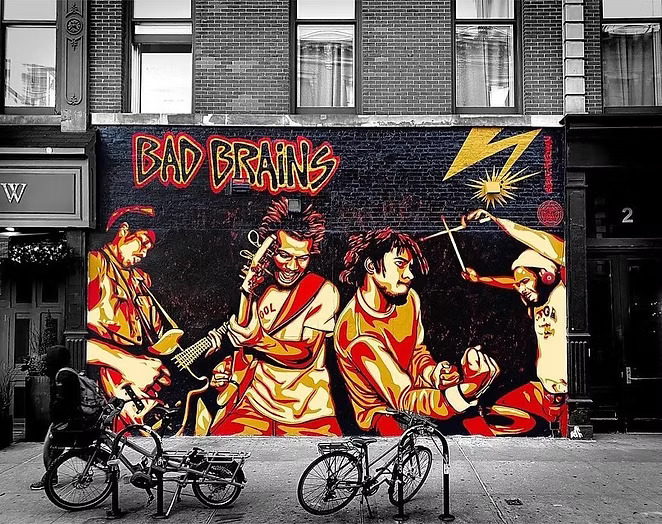
This mural of 80’s punk/hardcore band Bad Brains, created by legendary artist Shepard Fairey, lives just a few blocks away from New York Theatre Workshop.
Another key inspiration for starting LISA Project? The cost of living in New York City, which for most New Yorkers, doesn’t leave them a budget for purchasing fine art. Wayne’s thought process went, “Well if I can’t afford to own a painting by my favorite artist, maybe instead we could put up a 6-foot version of that painting outside, for everybody.” Street art is a remarkably accessible medium—truly “art for the streets”, as the LISA team calls it. Wayne sums up the seeds of the organization as “financial struggles, coupled with a love for the art and the artists we work with, as well as the need to share that artwork with the community.”
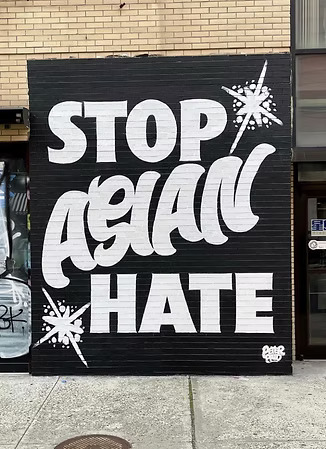
Artist Peter Paid’s collaboration with LISA Project.
In addition to being accessible, street art inherently exists in conversation with its environment, a fact that LISA Project doesn’t take for granted. The team thought, “Maybe we should paint some murals to beautify the neighborhood and… remind people why the East Village is awesome”, as Wayne recounted. I asked him about how the LISA team considers the history and needs of a neighborhood when planning a project for that area. Primarily, he described the importance of collaborating with other community arts organizations, such as Thrive Collective, whose murals are created directly with community members and specifically manifested on school buildings. Wayne explained that by partnering with each other, the public art charities of NYC can divvy up different neighborhoods and artistic subjects amongst themselves in the effort to cover more ground, both literally and thematically. For example, the street art of Groundswell, a Brooklyn-based organization, centers the need for racial justice and liberation, and their work specifically uplifts the Black and brown people of the Brooklyn neighborhoods they serve. LISA Project sometimes plays matchmaker between the artists they work with and the neighborhoods of NYC, facilitating partnerships between street artist and community that feel purposeful or authentic to the artist’s identity.
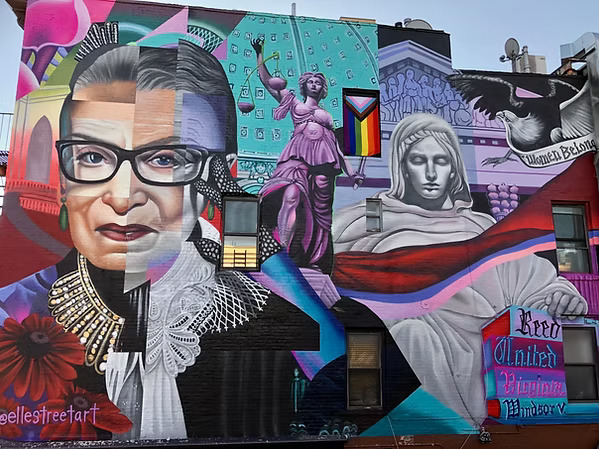
Artist ELLE painted this kaleidoscopic tribute to Justice Ruth Bader Ginsburg.
Perhaps my favorite part of my conversation with Wayne was hearing his reflections on especially meaningful experiences he’s had through LISA Project NYC. I watched him light up as he recalled the wide variety of impactful moments cultivated by the charity’s inspirational work—from collaborating on a mural dedicated to the people of Palestine, to seeing little girls dressed up as Ruth Bader Ginsburg for Halloween proudly take photos in front of LISA’s RBG mural. Another project that was especially close to the LISA founders’ hearts was their partnership with the Make-A-Wish Foundation, because Rey Rosa was a former Make-A-Wish kid. LISA Project commissioned artist Peach Tao to create the whimsical and delightful mural that now graces the side of Brookdale Hospital East in honor of pediatric patients.
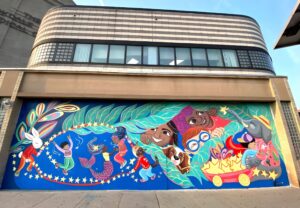
Artist Peach Tao’s work for LISA Project’s partnership with the Make-A-Wish Foundation.
As for the future of the NYC art scene, Wayne’s chief hope is for more of the city’s physical spaces to be dedicated to artmaking, of all disciplines. He reflected on how, although the NYC administrations of the past couple decades have promised more allocated studio space, they typically haven’t delivered it. Wayne has observed that “promised studio space often becomes more offices, housing, or something else”. This disparity was likely another catalyzer in the development of street art as a medium; visual artists with no access to studio space started taking to the streets to create.
Fourteen years on from the New York Comedy Festival, taking to the streets still defines Wayne’s approach to community collaboration. At a time when it feels increasingly difficult to connect with our neighbors, his advice is that if a place looks interesting, “just go inside and talk to someone, and give them a little piece of art.”
Explore more
Categories: Community Spotlight and For The Culture. Tags: Education & Engagement, For The Culture, and In Honor of Jean-Michel Basquiat.